• Skip to main content
  • Skip to primary sidebar
  • Skip to footer

Brighton Music Academy

Music Lessons for all ages

  • Home
  • Lessons
    • Piano Lessons
    • Guitar Lessons
    • Voice Lessons
    • Drum Lessons
    • Bass Guitar Lessons
    • Ukulele Lessons
    • Violin Lessons
    • Viola Lessons
    • Cello Lessons
    • Upright Bass Lessons
    • Saxophone Lessons
    • Clarinet Lessons
    • Flute Lessons
    • Trumpet Lessons
    • Trombone Lessons
    • Preschool Music
    • Group Singing Classes
  • Teachers
  • Enroll Online
  • Contact Us
    • Locations
      • Brighton Music Academy
      • Dixboro Music Academy
      • Canton Music Academy
      • Grosse Pointe Music Academy
      • New Hudson Music Academy
  • About
    • Blog
    • Calendar
    • Customer Portal
    • Merch Store
    • Instrument Rentals
    • Rent Now!
How To Memorize Major Scales

How To Memorize Major Scales

October 6, 2024 By brighton

How to Memorize Major Scales


By Henry Bahrou, Guitarist, Music Theorist, and Music Academy Director

Memorizing major scales is an essential skill for musicians, yet it’s something many tend to overlook. Whether you’re playing guitar, piano, or any other instrument, major scales form the foundation for a lot of music theory. Without understanding them, many other musical concepts can feel out of reach. The good news is that learning and memorizing major scales doesn’t have to be difficult, and in this post, I’m going to share an approachable method that worked for me and many others.

What Are Major Scales?

In the world of Western music, we work within a 12-tone system. However, there are 15 written major scales that cover those 12 tones. How is this possible? Some scales are enharmonic, meaning they can be written in two different ways but sound the same. For example, the notes in C♯ major and D♭ major are enharmonic—they’re the same sound but written differently.

When we talk about the “spelling” of a scale, we’re referring to the way the notes are written out, much like how a word or name is spelled. Getting the spelling right is key to understanding music theory on a deeper level. And while it might seem like a lot to memorize, breaking it down step by step can make it simple and even enjoyable.

The Importance of Memorizing Major Scales

Major scales are the building blocks of many aspects of music theory. Understanding them will not only help you navigate your instrument but also open the door to grasping key signatures, chord progressions, and modes. If you’re serious about improving as a musician, getting these scales down is crucial.

That said, if you’re not looking to dive deep into music theory, you might be tempted to skip learning these scales. But for those who are ready to take the plunge, I can assure you that it’s a worthwhile investment.

My Method: Repetition and Reciting

When I was in college, I had to memorize the 15 major scale spellings as part of a music theory class. Here’s what we did: every day for a month, we were assigned to write out all 15 major scales on staff paper, locate them on the piano keyboard, and write out their letter names and accidentals. This consistent repetition made memorizing them feel effortless after just a couple of weeks. By the end of the month, they were locked into memory.

While this method may sound tedious, it works because it taps into two key learning strategies: writing and repetition. The physical act of writing out the scales helps reinforce the muscle memory, while repeating them daily solidifies the information in your long-term memory.

Why Use a Piano to Learn Scales?

Even though I’m a guitarist, I recommend using the piano when learning scales. The piano’s layout of black and white keys makes it easy to visualize natural notes and accidentals. On a guitar, things can get a bit more abstract since the notes aren’t laid out in a straight line like they are on a piano. The simplicity of the piano keys makes it an ideal tool for seeing how the scales work.

That said, guitarists can still benefit from labeling the scales on their instrument too. In fact, in my book, I’ve included tablature to help guitar players understand the scales better, but it’s not essential to the memorization process.

To make this process easier, I’ve created a 30-day workbook that walks you through the steps of memorizing the major scales. It breaks the task down into manageable chunks, so you can focus on one thing at a time. Each day, you’ll write out the scales and practice locating them on the piano. After a month, you’ll have them memorized.

A Simple 30-Day Plan

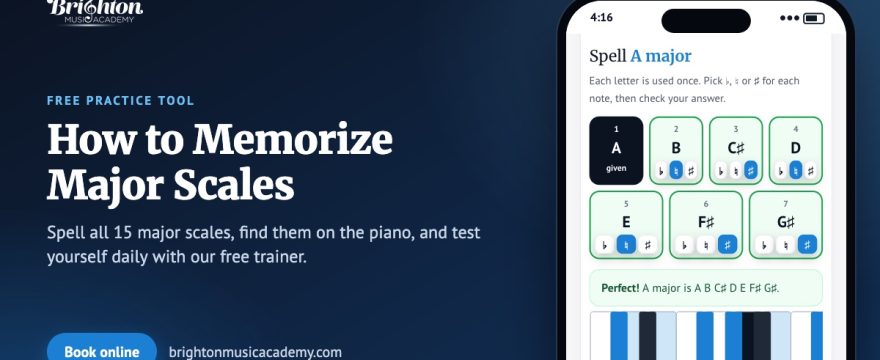
Here’s a link to the book if you’re interested: How to Memorize Major Scales Workbook. You can either grab a copy on Amazon, or if you prefer, I’ve made a PDF version available for free—just click the link How to Memorize Major Scales.

How to Memorize Major Scales

Final Thoughts

Learning major scales might seem daunting at first, but with a consistent method, it’s easier than you think. Remember, memorizing these scales is not just about learning patterns; it’s about gaining a deeper understanding of how music works. By taking it one day at a time and following the process I’ve outlined, you’ll have all 15 major scales committed to memory before you know it.

If you’re ready to improve your musical knowledge and gain a stronger command of your instrument, now’s the time to start. Grab the workbook, set aside a little time each day, and soon, memorizing major scales will feel second nature. Happy practicing!


Henry Bahrou is a Guitarist, Music Theorist, and Music Academy Director dedicated to helping musicians of all levels understand music theory through practical, approachable methods.

Serving Brighton, Howell, Pinckney, Hamburg Township, Green Oak Township, Genoa Township, Brighton Township, South Lyon, Whitmore Lake, Fowlerville, New Hudson, Ann Arbor, Hartland Township, Byron, Linden, Fenton, Holly, Highland, Milford, Williamston, Gregory.

Filed Under: Music Theory, Products, Uncategorized Tagged With: Books, Major Scales

Convenient Location

Come learn music with us at our facilities, which are conveniently located on Grand River in Brighton. We prioritize safety and cleanliness, and will always maintain a proper atmosphere for all of our students.

Private Lesson Programs Offered:

Available in 30-min, 45-min, and 60-min


  • Piano Lessons
  • Guitar Lessons
  • Voice Lessons
  • Drum Lessons
  • Bass Guitar Lessons
  • Violin Lessons
  • Viola Lessons
  • Cello Lessons
  • Upright Bass Lessons
  • Ukulele Lessons
  • Saxophone Lessons
  • Clarinet Lessons
  • Flute Lessons
  • Trumpet Lessons
  • Trombone Lessons

Primary Sidebar

Request Info Form

Recent Posts

  • How Long Does It Take to See Progress in Music Lessons?
  • What Should Beginners Practice First?
  • What Age Should Children Start Music Lessons?
  • New Year Music Lessons in Brighton, Michigan
  • Brighton Music Academy Holiday Break 2025

Footer CTA

Services

Piano Lessons

Guitar Lessons

Voice Lessons

Drum Lessons

Bass Guitar Lessons

Violin Lessons

Viola Lessons

Cello Lessons

Upright Bass Lessons

Ukulele Lessons

Saxophone Lessons

Clarinet Lessons

Flute Lessons

Trumpet Lessons

Trombone Lessons

  • Facebook
  • Privacy Policy
2026 • Brighton Music Academy • All Rights Reserved