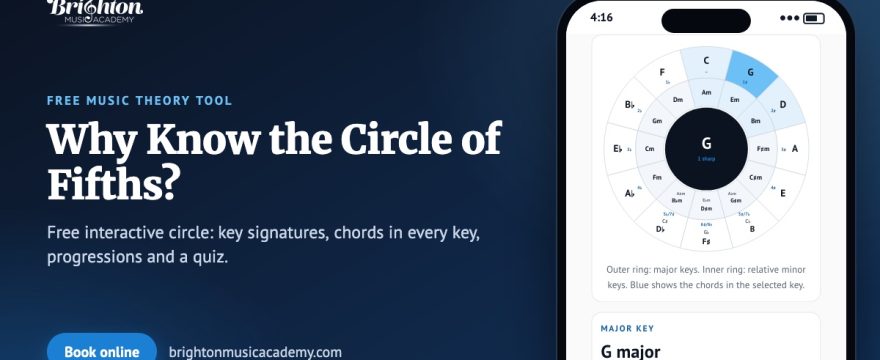
The circle of fifths is a road map for scales, chords and key signatures. Tap any key on the interactive circle below to see its key signature, chords and closest keys, then test yourself with the quiz. Below the tool are ten reasons every musician should know it.
Free practice tool
Interactive Circle of Fifths
Tap any key to see its key signature, its chords and the keys closest to it. Then test yourself with the key signature quiz.
Outer ring: major keys. Inner ring: relative minor keys. Blue shows the chords in the selected key.
Major key
C major
Chords in this key
Tap a chord to hear it.
Try these progressions
Key signature quiz
Which major key is this?
Tap the answer on the circle.
Clockwise adds a sharp
Each step to the right goes up a fifth (C to G to D) and adds one sharp.
Counterclockwise adds a flat
Each step to the left goes up a fourth (C to F to B♭) and adds one flat.
Neighbors sound good together
The keys on either side, and the minors under them, share most of their notes. That’s why I, IV and V work so well.
Order of sharps and flats
Sharps: F C G D A E B ("Father Charles Goes Down And Ends Battle"). Flats are the same letters backwards.
What is the circle of fifths?
The circle of fifths arranges all 12 notes in a circle. Moving clockwise, each note is a perfect 5th higher than the last (C to G). Moving counterclockwise, each is a perfect 4th higher (C to F). That symmetry between 4ths and 5ths is what makes it such a powerful map of how notes and keys relate.
10 reasons to know the circle of fifths
1. Understanding intervals
The 5th is one of the most important intervals in music, and the circle makes it, and its inverse the 4th, easy to see and hear. Those two intervals are the foundation of chord progressions, chord building and key relationships.
2. Harmony and chord structure
After the octave, the 5th is the most prominent overtone a vibrating string produces. That’s why it sits in every major and minor chord, whether it’s A major, C minor or E major.
3. Chord progressions
The most common progressions are built on I, IV and V, like C, F and G in C major. On the circle those three keys sit side by side, which shows how closely related they are. Neighboring keys are also the easiest to modulate to. Tap a key above to see its chords and try the suggested progressions.
4. Major and minor scales
Any seven neighbors on the circle spell a major scale. F, C, G, D, A, E and B are exactly the notes of C major. Knowing that helps you see scale patterns on the keyboard or fretboard. Our Major Scale Trainer lets you practice all 15.
5. Key signatures
Each step clockwise adds a sharp: C has none, G has one, D has two, and so on. Each step counterclockwise adds a flat. The sharps themselves are added in the order of fifths, F C G D A E B, and the flats in the order of fourths, B E A D G C F.
6. Tuning string instruments
Violins, violas, cellos and mandolins are tuned in 5ths. Bass guitar is tuned in 4ths, and standard guitar uses 4ths with one major 3rd (between the G and B strings). The circle helps explain why these tunings work and how to find your way around the neck.
7. Memorizing scales with tetrachords
A tetrachord is a group of four notes. A major scale is two of them: C-D-E-F and G-A-B-C in C major. The upper tetrachord of C major is the lower tetrachord of G major, the next key clockwise. Moving around the circle, you only learn four new notes at a time.
8. Relative minor keys
Every major key has a relative minor that shares its key signature, shown on the inner ring of the circle. To find it, go a whole step above the 5th of the major key: the 5th of C is G, and a whole step above G is A, so the relative minor of C major is A minor.
9. Transposing and modulating
The circle makes it easier to move a melody or chord progression to a new key, whether to suit a singer’s range or another instrument, and to change keys smoothly within a song.
10. A bigger picture of music
The more theory you study, the more uses you’ll find for the circle. A memory trick helps: the order of sharps is “Fat Cats Go Down Alleys Eating Birds,” and the order of flats is the same letters backwards.
Free circle of fifths PDF
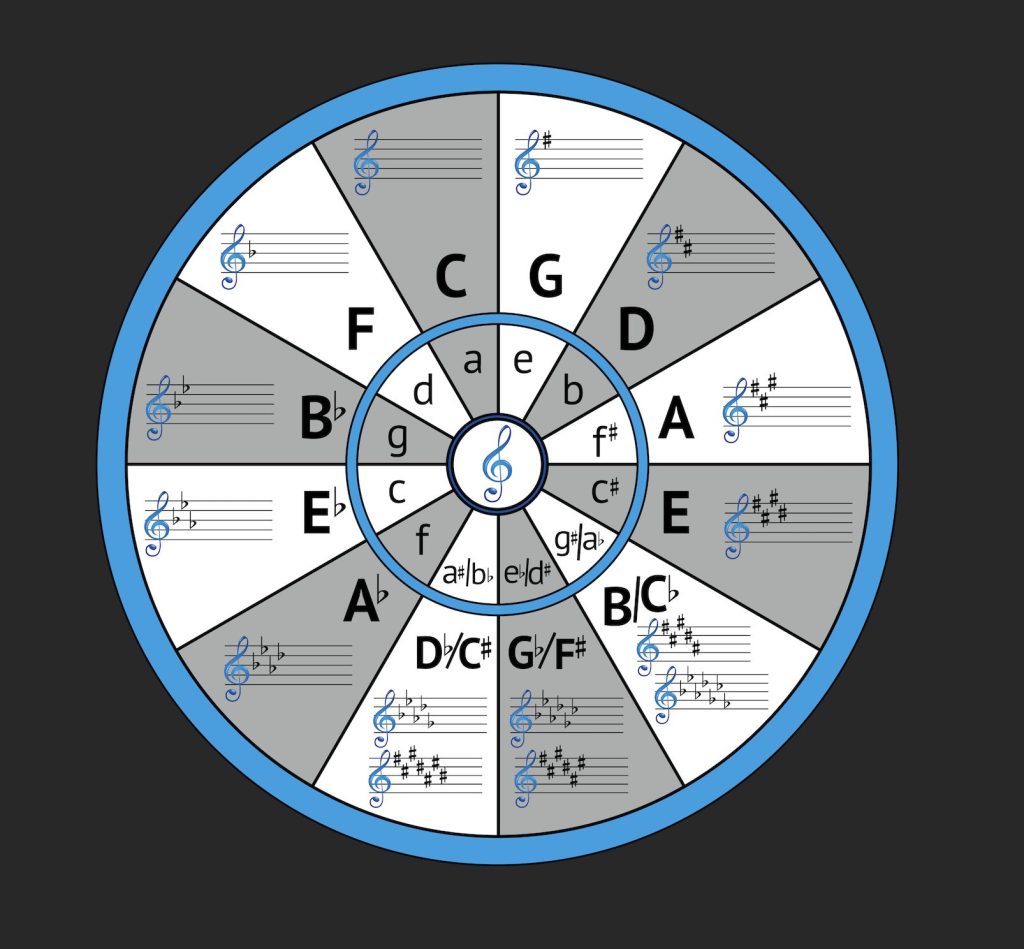
Print our circle of 5ths chart for your music stand, practice room or binder. It’s free, with no sign-up needed.
⬇ Download the PDFConclusion
So why is it important to know the circle of fifths? It organizes the world of music, making intervals, chords, scales, key signatures and transposition easier to understand. Whether you’re a beginner or an advanced player, it gives you a solid foundation for everything else.