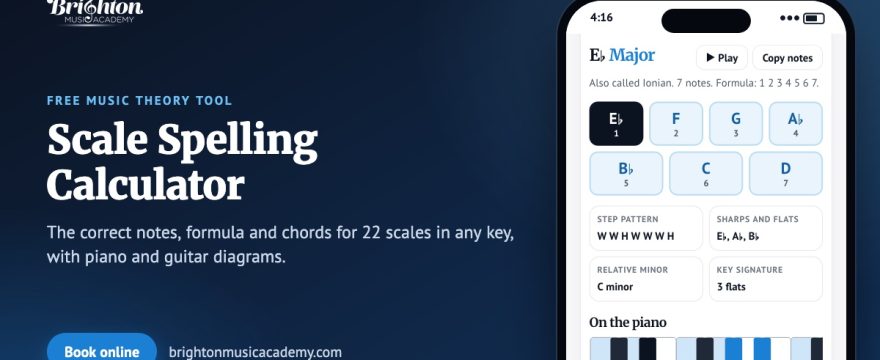
Pick a root note and a scale to get its correct spelling, with every note named the way it’s written on the staff. You also get the formula, the step pattern, the notes on piano and guitar, and the chords that come from the scale.
Brighton Music Academy · Theory tool
Scale Spelling Calculator
22 scales from any of 17 root notes, spelled correctly every time.
C Major
On the piano
On the guitar
Tap any key or dot to hear it.
Chords in this scale
Tap a chord to hear it.
How to spell a scale
Spelling a scale means naming each note the way it’s written in music notation. Two notes can sound the same but be spelled differently, like F♯ and G♭, and the right choice depends on the scale. A few rules cover almost every case:
- Use each letter once. A 7-note scale like major, minor, harmonic minor or any of the modes uses all seven letters, A to G, in order. That’s why D major has F♯ and not G♭: the scale already has a G.
- Follow the formula. Every scale is a pattern of whole steps (W) and half steps (H). Major is W W H W W W H. Natural minor is W H W W H W W.
- Sharps or flats, not both. Major and natural minor scales use only sharps or only flats. Scales like harmonic minor can mix them, because the raised 7th is written as a sharp or natural.
- Double sharps and flats are real. D♯ major needs an F double sharp (F𝄪) to keep one note per letter. Keys like that are called theoretical keys, and musicians usually switch to the enharmonic key (E♭ major) instead. The calculator warns you and offers the switch.
- Pentatonic and blues scales skip letters. Five- and six-note scales leave letters out, so they follow the parent scale’s spelling. A minor pentatonic is A, C, D, E, G.
Scale formulas
Each formula compares the scale to the major scale with the same root. Tap a scale name to load it in the calculator.
| Scale | Formula | Steps | In C |
|---|
Who it’s for
Students use the Scale Spelling Calculator to check written theory homework. Songwriters use it to find the notes of a key fast, and teachers use it to show why a scale is spelled the way it is. It works for guitar, piano, voice, strings, woodwinds and brass, because the spelling is the same on every instrument.
Want to learn scales hands-on? Our teachers cover theory, reading and improvisation in private music lessons in Brighton.