• Skip to main content
  • Skip to primary sidebar
  • Skip to footer

Brighton Music Academy

Music Lessons for all ages

  • Lessons
    • Piano Lessons
    • Guitar Lessons
    • Voice Lessons
    • Drum Lessons
    • Violin Lessons
    • Bass Guitar Lessons
    • Ukulele Lessons
    • Viola Lessons
    • Cello Lessons
    • Upright Bass Lessons
    • Saxophone Lessons
    • Clarinet Lessons
    • Flute Lessons
    • Trumpet Lessons
    • Trombone Lessons
    • Oboe Lessons
    • Preschool Music
  • Programs
    • Group Singing Classes
  • Teachers
  • Pricing
  • Contact
    • Locations
      • Brighton Music Academy
      • New Hudson Music Academy
      • Dixboro Music Academy
      • Canton Music Academy
      • Grosse Pointe Music Academy
  • About
    • Blog
    • Free Music Tools
    • Recital
    • Calendar
    • Customer Portal
    • Merch Store
    • Instrument Rentals
  • Book Now
What Is the Significance of the Melodic Minor Scale?

What Is the Significance of the Melodic Minor Scale?

October 15, 2024 By brighton

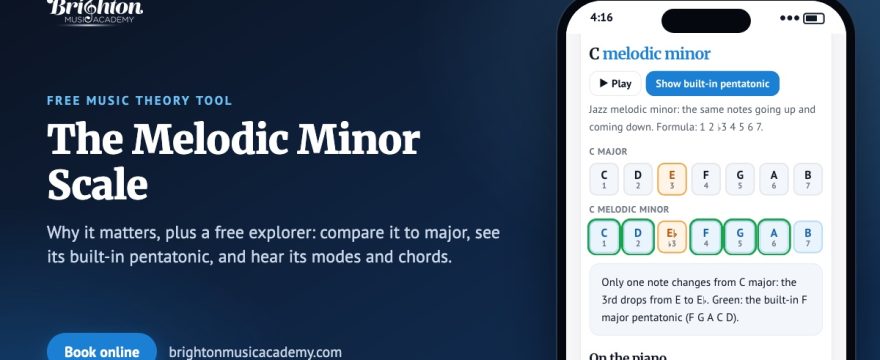
The melodic minor is far more than a classical exercise. It’s the only scale besides the major scale built entirely from whole and half steps with no two half steps in a row, and it’s full of fresh harmony. Explore it below, then read why it matters.

Free music theory tool

Melodic Minor Explorer

See the melodic minor in any key, compare it with major and natural minor, and hear its modes and chords.

1 Key
2 Version

C melodic minor

On the piano

On the guitar

Chords in C melodic minor

The 7 modes of C melodic minor

Tap a chord or mode to hear it and light it up on the piano and guitar.

A scale that changes direction

In classical music theory, the melodic minor is taught as a scale that goes up one way and comes down another. Ascending, it raises the 6th and 7th notes of the natural minor scale. Descending, it returns to the natural minor (Aeolian mode). The name comes from this focus on melodic direction, which makes it unusual in Western music. Scales that change with direction are much more common in Indian classical music, where many ragas ascend and descend differently.

More than an altered natural minor

Jazz and modern players use the ascending form both ways, and treat it as a 7-note scale system of its own, just like the major scale. That’s where its real value shows up: in its harmony.

The melodic minor is the only other scale besides the major scale built entirely from whole and half steps with no two half steps in a row. It’s one note away from the major scale: lower the 3rd and you have it. So it feels familiar, with similar harmonic structures, but brings a fresh set of colors. You can see exactly which chords it keeps and changes in our Scale Harmony Explorer.

A built-in pentatonic scale

The melodic minor contains a major pentatonic scale built on its 4th note, using the 4th, 5th, 6th, root and 2nd. In C melodic minor that’s F, G, A, C and D. Pentatonic scales avoid the tense minor 2nd and tritone, so they give you a simple, open-sounding framework for melodies inside the scale. Tap Show built-in pentatonic above to see it.

Why guitarists love it

In standard tuning, the open strings E, A, D, G and B form a pentatonic scale (E minor or G major pentatonic), and those notes sit inside D melodic minor. That makes melodic minor sounds easy to reach on guitar, and a natural next step for players looking for an alternative to the major scale.

Watch: the melodic minor scale

The bottom line

The significance of the melodic minor lies in its distinctive harmonic and melodic palette. Its close relationship to the major scale, combined with that one changed note, gives you a powerful tool for new melodies and harmonies. Whether you want fresh chords or just an alternative to the major scale, the melodic minor is worth knowing.

By Henry Bahrou, guitarist, music theorist and music academy director

Guitar lessons in Brighton How to memorize major scales How to Memorize Major Scales (book) Scale Spelling Calculator The circle of fifths

Filed Under: Guitar Tagged With: Music Theory

Convenient Location

Brighton Music Academy
Ready to start music lessons in Brighton?

Come learn music with us at our facilities, which are conveniently located on Grand River in Brighton. We prioritize safety and cleanliness, and will always maintain a proper atmosphere for all of our students.

30 min45 min60 min
Book Your First Lesson
Call / Text (810) 775-3476

Private lessons we offer

Piano
Guitar
Voice
Drums
Violin
Bass Guitar
Viola
Cello
Upright Bass
Ukulele
Saxophone
Clarinet
Flute
Trumpet
Trombone
  • Facebook
  • Instagram
  • Twitter
  • YouTube

Primary Sidebar

Brighton Music Academy Start music lessons
Private one-on-one lessons Kids, teens & adults 30, 45 or 60 minutes
Book Your First Lesson Call / Text (810) 775-3476 719 W. Grand River Ave, Brighton

Request Info Form

Footer CTA

Visit Us Brighton Music Academy

719 W. Grand River Ave
Brighton, MI 48116

View Map →
(810) 775-3476

Call or text

info@brightonmusicacademy.com
Cities We Serve Near Brighton
Brighton Howell Fenton Pinckney Hartland Holly Highland Linden
View All Areas →
Also Serving Southeast Michigan
Ann Arbor (Dixboro) South Lyon / New Hudson
Music Lessons
🎹 Piano 🎸 Guitar 🎤 Voice 🥁 Drums 🎻 Violin + More
View All Instruments →
Company
Our Teachers Contact Us Book a Lesson
Get Started

Easy online enrollment and flexible scheduling.

Enroll Online Call / Text (810) 775-3476 Request Info →
  • Facebook
  • Privacy Policy
  • Sitemap
2026 • Brighton Music Academy • All Rights Reserved