Brighton Music Academy
One of the most common questions we hear from parents is:
“How do we actually build a practice routine that sticks?”
The truth is, music progress doesn’t come from random bursts of motivation. It comes from small, repeatable habits.
And the good news? It doesn’t have to be complicated.
1. Pick a Time That Makes Sense for Your Family
Routine works best when it connects naturally to your day.
Whenever possible, choose a consistent time — just like exercise or brushing teeth.
Some options that tend to work well:
- Right after school – Short session before the evening gets busy.
- Before school – Quiet, focused time if your home allows it.
- After sports or activities – The body is tired and ready to sit. This can actually be a perfect moment.
The exact time matters less than the consistency.
If it happens “whenever we get to it,” it usually doesn’t happen.
2. Make the Practice Space Easy and Inviting
This is one of the most overlooked parts of practice success.
If a student has to:
- Dig through a backpack
- Clear off a desk
- Find their music
- Move furniture
… practice becomes a chore before it even begins.
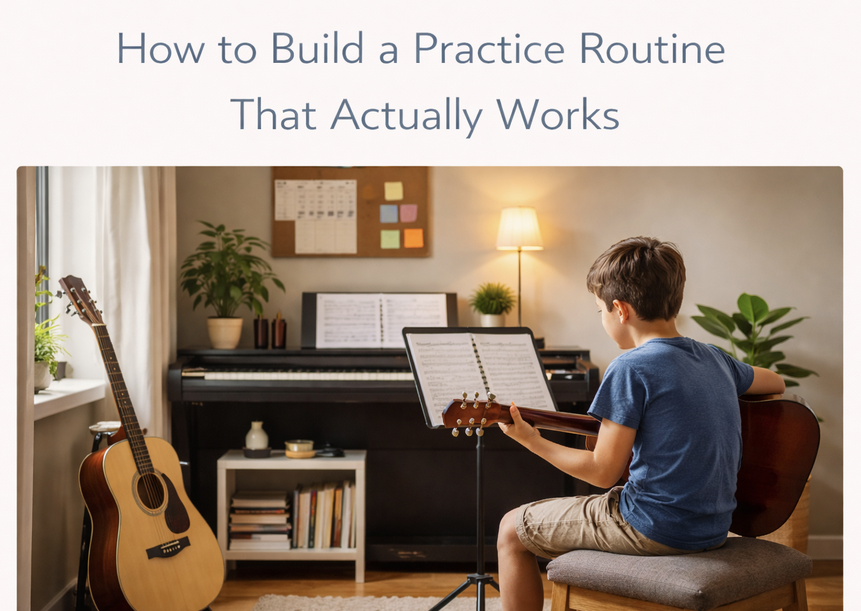
Instead, create a simple, ready-to-go space:
- Instrument accessible
- Music stand set up
- Books stacked neatly
- Chair positioned properly
- Good lighting
For piano and drums, the instrument stays in one place.
For guitar, violin, or other portable instruments, a dedicated corner of the room makes a huge difference.
The easier it is to start, the more likely it happens.
3. Focus on Consistency, Not Perfection
Practice does not need to be dramatic.
It does not need to be an hour.
It does not need to sound amazing.
It just needs to happen regularly.
Some days will feel inspired.
Some days will feel mechanical.
That’s normal.
Musicians are built through repetition. Confidence comes from skill — and skill comes from showing up again and again.
4. Expect a Mental Adjustment Period
Especially in the beginning, practice can feel unfamiliar.
Students may think:
- “Why am I playing this scale again?”
- “Why does this simple part feel hard?”
- “Why can’t I just play the whole song?”
Music is a real skill. It takes time for the brain and hands to connect.
Often, what looks like “nothing happening” is actually a lot happening internally.
Stay steady. The growth shows itself.
5. Adjust When Needed
If practice feels stale:
- Change up the material.
- Ask the teacher for something new.
- Add a fun song alongside technical work.
- Prepare something small for a recital.
Recitals can be motivating for many students — not because they want to be performers, but because they want to complete something and share it.
For more creatively-minded students, motivation may come from mastering a favorite song instead.
Either way, the goal is momentum.
6. Keep It Positive
Practice should not feel like school.
It should feel like building something.
Instead of:
“Go practice.”
Try:
“Show me what you worked on.”
That shift alone changes the energy.
Music grows best in an environment that feels supportive and steady — not pressured.
The Bigger Picture
A strong practice routine doesn’t form overnight.
It builds gradually.
At Brighton Music Academy, we’ve seen students develop lifelong discipline simply by:
- Having a consistent lesson schedule
- Showing up each week
- Practicing in small, manageable ways
- Adjusting expectations when needed
Routine eventually establishes itself.
And once it does, progress feels natural.
If you’re ready to help your child build real musical habits in a supportive environment, we’re here to help.
Enroll Now – Brighton Music Academy
Continue learning how to support your child’s musical growth at home and in lessons.
Related Reading
Popular Private Lesson Programs in Brighton
- Piano Lessons in Brighton
- Guitar Lessons in Brighton
- Voice Lessons in Brighton
- Drum Lessons in Brighton
- Violin Lessons in Brighton
Our Sister Music Academies