Why Is It Important to Know the Circle of Fifths?
The Circle of Fifths is an essential tool for musicians, serving as a road map to better understand scales, chords, and key signatures. But why is it important to know the Circle of Fifths? Let’s start with what the Circle of Fifths is and then explore why mastering it is crucial for any musician.
What Is the Circle of Fifths?
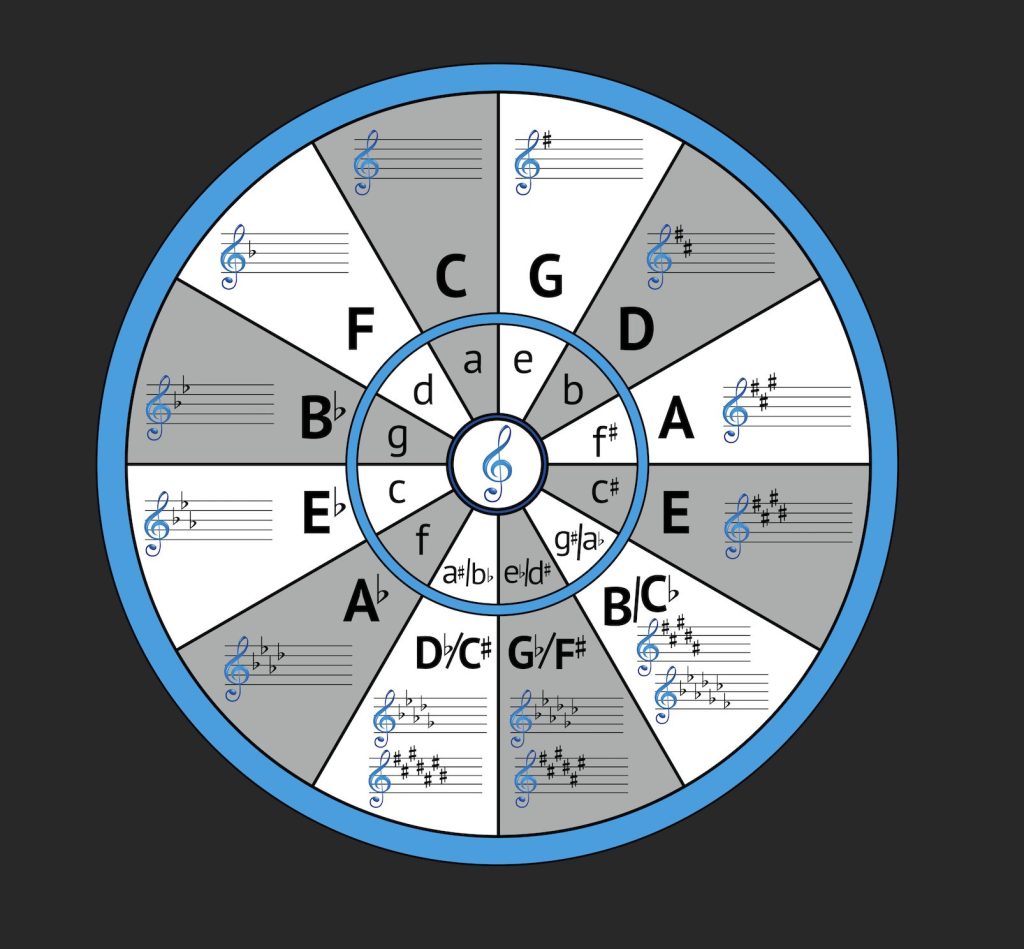
The Circle of Fifths is a diagram that shows all 12 notes of the chromatic scale arranged in a circular pattern. Moving clockwise, each note is a perfect 5th above the previous one (for example, from C to G). Moving counterclockwise, each note is a perfect 4th above the previous one (for example, from C to F). This symmetry between 4ths and 5ths makes the Circle of Fifths a powerful tool for understanding the relationships between notes and keys.
Why Musicians Should Know the Circle of Fifths
1. Understanding Intervals
An interval is the distance between two notes, and the 5th is one of the most important intervals in music. The Circle of Fifths helps musicians visualize and internalize the interval of the 5th, as well as its inverse, the 4th. These intervals are foundational in creating harmonic progressions, constructing chords, and understanding key relationships. Why is it important to know the Circle of Fifths? Because it helps you master these critical intervals and apply them to all areas of your playing.
2. Harmonics and Chord Structures
The 5th is not just an arbitrary interval—it’s the second overtone in the harmonic series. Every vibrating note produces overtones, and after the octave, the 5th is the most prominent. This makes the 5th a fundamental component of harmony. When playing a major or minor chord, the 5th of the root note is always present, whether it’s an A major, C minor, or E major chord. Knowing the Circle of Fifths can help you understand how these harmonic relationships work in every chord you play.
3. Chord Progressions and Harmony
Many of the most common chord progressions in Western music are built on 1-4-5 (I-IV-V) relationships, such as C, F, and G in the key of C major. These chords are positioned next to each other on the Circle of Fifths, showing how closely related they are harmonically. By understanding why the Circle of Fifths is important, you’ll be able to quickly recognize these relationships and use them to build more cohesive, musically pleasing chord progressions. The Circle of Fifths also aids in modulating between keys, as closely related keys are positioned next to each other on the circle.
4. Major and Minor Scales
Another important function of the Circle of Fifths is revealing the relationships between major and natural minor scales. As you move around the circle, you’ll notice that consecutive fifths outline the notes of major scales. For example, moving from F to C to G to D spells out the notes in the C major scale. This pattern holds true for any major scale, and knowing the Circle of Fifths allows you to visualize these scale patterns across the fretboard or keyboard.
5. Key Signatures and Sharps/Flats
One of the most practical applications of the Circle of Fifths is understanding key signatures. Sharps and flats are added according to the order of fifths and fourths. Moving clockwise around the circle, each key signature gains one sharp (C has none, G has one sharp, D has two sharps, and so on). Moving counterclockwise, each key adds a flat. This makes it easier to memorize key signatures and understand their relationships to one another.
6. Tuning of String Instruments
Many stringed instruments are tuned in 4ths or 5ths, making the Circle of Fifths a valuable resource for players. Violins, mandolins, and cellos are tuned in 5ths, while bass guitars and standard guitars use a mix of 4ths and 3rds. Understanding the Circle of Fifths will give you a deeper insight into why these tunings work and how to navigate the fretboard more easily.
7. Memorizing Scales Using Tetra Chords
The Circle of Fifths can help you memorize scales more efficiently by using tetra chords, which are groups of four consecutive notes. The first four notes of any major scale (for example, C-D-E-F in the key of C) and the last four notes (G-A-B-C) form tetra chords. As you move around the Circle of Fifths, you’ll notice how these four-note groupings repeat across different keys. This makes it easier to remember scales without needing to memorize all seven notes at once.
8. Navigating Relative Minor Keys
Each major key has a relative minor key, which shares the same key signature. The Circle of Fifths makes it easy to find these relative minors. For example, the relative minor of C major is A minor, and you can quickly find this by moving a whole step above the 5th of C (which is G). Knowing the Circle of Fifths helps you navigate between major and minor keys seamlessly, which is especially useful when composing or improvising.
9. Transposition and Modulation
Understanding the Circle of Fifths makes transposing and modulating between keys much easier. By moving around the circle, you can shift a melody or chord progression from one key to another while maintaining harmonic integrity. This is a valuable skill for musicians who perform with different instruments or vocal ranges and need to quickly adapt to new keys.
10. Broader Musical Understanding
Finally, mastering the Circle of Fifths gives you a broader understanding of music theory and harmony. As you read more articles and study other musicians’ approaches, you’ll discover even more applications of the Circle of Fifths. It’s a tool that extends beyond chords and scales, helping you understand how music is structured on a deeper level. Plus, you can create your own mnemonic devices to help memorize the order of fifths, such as “Fat Cats Go Down Alleys Eating Birds.”
Conclusion: The Importance of the Circle of Fifths
So, why is it important to know the Circle of Fifths? It simplifies and organizes the vast world of music, making it easier to understand intervals, chords, scales, key signatures, and transposition. Whether you’re a beginner or an advanced player, mastering the Circle of Fifths will provide a solid foundation for navigating the musical landscape. Be sure to download our free PDF Circle of 5ths Image!
by Henry Bahrou – Guitarist, Music Theorist, Music Academy Director
What Is the Significance of the Melodic Minor Scale?